Presentation of the QUETZAL-2 Satellite at Science from the Vice Presidency
The UVG Aerospace Laboratory shared the advances of the QUETZAL-2 satellite during the scientific outreach program held at the National Palace of Culture
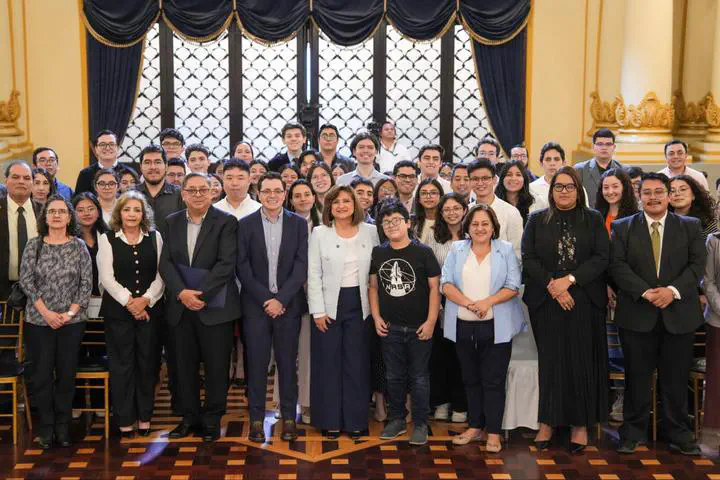 Presentation of the QUETZAL-2 project advances at Science from the Vice Presidency.
During the scientific outreach program Science from the Vice Presidency, held at the National Palace of Culture, advances on the QUETZAL-2 satellite project, developed by the Aerospace Laboratory at Universidad del Valle de Guatemala (UVG), were presented. The event was part of the initiatives by the Vice Presidency of Guatemala to highlight the role of science and technology in the country’s development.
The QUETZAL-2 satellite, formally initiated in August 2024, is currently in its second phase, focused on the integration of key subsystems. The satellite launch is planned for 2028 and represents an important step toward consolidating national capabilities in engineering and space technology.
During her remarks, the Vice President of Guatemala, Dr. Karin Herrera, highlighted the work driven by Guatemalan youth and emphasized that scientific and technological development must be a central pillar for the country’s progress. “Without science, without education, and without food on children’s tables, it is not possible to speak of comprehensive and sustainable development,” she stated.
The Vice President also expressed national pride in QUETZAL-2, selected by the United Nations as one of the four winning projects of the EXOpod program, a recognition that positions Guatemala as a leader in emerging satellite initiatives.
For his part, José Antonio Bagur, coordinator of the Aerospace Laboratory, recalled that Guatemala became a spacefaring nation with the launch of the QUETZAL-1 nanosatellite in March 2020, and that QUETZAL-2 represents the natural evolution of that first mission.
The new satellite, a two-unit CubeSat (2U), will incorporate a more advanced architecture and aims to validate a responsible deorbiting system, implement artificial intelligence for autonomous satellite image analysis, and transmit real-time data to educational centers across the country. These advances seek to spark young people’s interest in aerospace sciences and strengthen Guatemala’s presence in space research at the regional and international level.