UVG signs launch contract for the second Guatemalan satellite, QUETZAL-2
The contract signing took place after the project was selected as one of four winners worldwide in the EXOpod program.
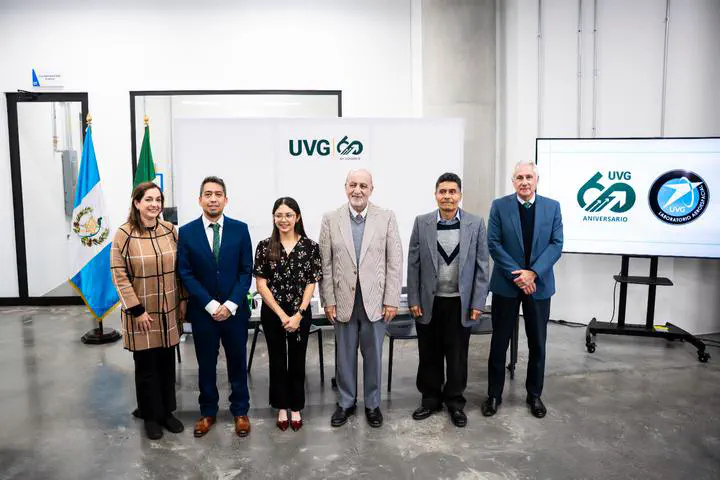 UVG authorities and Aerospace Laboratory representatives during the contract signing.
The EXOpod program, promoted by the United Nations Office for Outer Space Affairs (UNOOSA) and the German company Exolaunch, grants winners the transportation of their satellite to space. According to the contract, QUETZAL-2 must be delivered in 2028 to Exolaunch at their facilities in Berlin, Germany, and will subsequently be transported to the United States for its launch to space on a SpaceX Falcon 9 rocket.
The QUETZAL-2 mission seeks to increase interest in Science, Technology, Engineering, and Mathematics (STEM) among young people in Guatemala by transmitting satellite data that can be received at educational centers throughout the country using antennas built by students. Additionally, the satellite will also test a passive deorbiting system and an artificial intelligence model capable of detecting clouds in images taken by the satellite. This aims to prevent the transmission of cloud-covered images to Earth.
Currently, around 50 people, including students, professors, and researchers from UVG, participate in the project led by the Aerospace Laboratory, part of the institution’s Mechanical Engineering Department. The team is made up of students with an average age of 20 years who are studying programs such as mechanical engineering, industrial mechanics, electronics, mechatronics, and computer science, as well as degrees in physics, marketing, and business administration. An important fact to highlight is that the team is composed of 60% women.